

Our Office Was Established to Provide Exceptional Care for Keratoconus, and the Majority of Our Patients Have This Disease
Contact a Keratoconus Specialist
Fill out the info below to schedule a call with a member of our team who specializes in keratoconus.

The Keratoconus Specialists in Charlotte
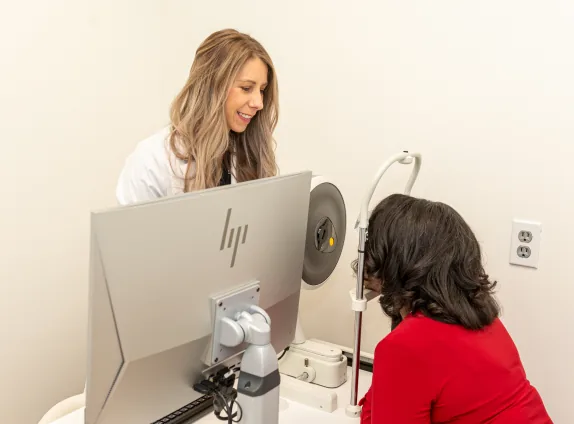
Around 75% of patients at the Charlotte Contact Lens Institute have keratoconus, a condition that is one of our primary focuses, setting us apart as a highly unique practice. The main focus of our office is providing vision solutions for keratoconus, which has led her to develop a deep expertise in maximizing patients’ vision and comfort in contact lenses. This includes maximizing long-term vision and ocular health by closely monitoring for potential progression with advanced technology.
If you have questions on keratoconus, we can be reached at (704) 800 5230 or hello@charlottecontactlens.com. More information on keratoconus can also be found below
- Doctors Who Specialize in Keratoconus, and Advanced Medical Devices Designed to Help Treat Keratoconus
- Initial Exams are ~ 2 hours of One-On-One Time With the Doctor
Looking for More Information on Keratoconus?
What is
Keratoconus?
Keratoconus is an ocular condition in which the cornea weakens and acquires a conical shape. This is often accompanied by thinning of this part of the cornea, and imperfections in the corneal curvature (astigmatism), which can become increasingly irregular and difficult to correct with glasses and conventional soft contact lenses.
Read More
Keratoconus usually occurs in both eyes, but due to significant asymmetry, many patients only notice impaired vision when their stronger eye is affected. By then the condition may already have caused severe and permanent loss of vision in the other eye. The condition usually begins in the late teens or early twenties. Keratoconus is much more common than previously thought. Recent studies have demonstrated that as many as 1 in 500 people may be affected by keratoconus.
Early forms of the disease can be undetected unless advanced scans of the surface of the eye are performed. For mild cases of keratoconus, eyeglasses or soft contact lenses may provide the patient with clear and comfortable vision. For moderate to advanced cases of keratoconus, eyeglasses or soft contact lenses will not provide clear vision, but specialty contact lenses can provide great vision!
Specialty Contact Lenses as a Treatment Option for Keratoconus
There is currently no cure for keratoconus, but at Charlotte Contact Lens Institute, we offer a variety of different management options for keratoconus. Often the best treatment option is a scleral contact lens, and we specialize in both free-form scleral lenses and traditional scleral lenses. Scleral lenses are designed to “vault” over the cornea and land on the white part of the eye.
Read More
Since scleral contact lenses are designed to avoid contact with the cornea, the wearer should feel entirely comfortable wearing them. The goal of scleral contact lens wear is to achieve clear vision without the sensation of having a contact lens in the eye.
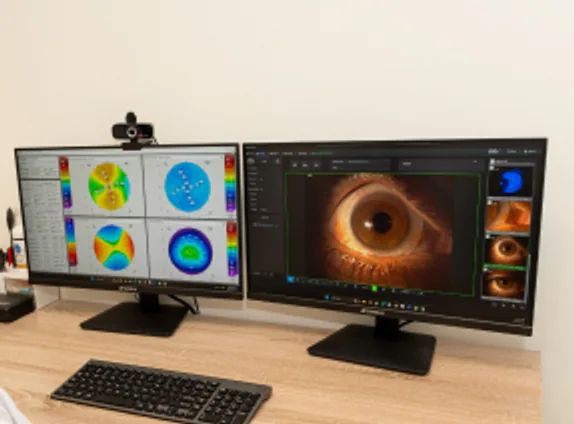
Charlotte Contact Lens Institute has technology designed specifically for patients with keratoconus. This technology collects up to 240,000 unique data points, and our doctors use this data to design a fully customized scleral contact lens.
What is Corneal Cross-Linking (CXL), and How Does it Help Treat Keratoconus?
Corneal cross-linking (also known as cross-linking) is a minimally invasive surgical procedure that uses ultraviolet light and eye drops to strengthen the collagen fibers in the cornea. While corneal cross-linking is helpful with strengthening the cornea and preventing further deterioration of vision, it is important to note that often patients still require scleral lenses to achieve clear vision.
Read More
A “cross linking evaluation” is a common type of office visit that we perform to determine if cross-linking may be a good option for your eyes. Many doctors in the Charlotte area refer their patients to our office for cross-linking evaluations, as there are limited offices in the Charlotte area with tomography systems to detect the earliest signs of progression with keratoconus. If you have questions on keratoconus or want to talk about your specific situation, we can be reached at (704) 800 5230 or hello@charlottecontactlens.com.
Does Keratoconus
Progress Over Time?
Keratoconus typically becomes apparent between the ages of 10 and 25. It usually progresses steadily until about the age of 40, but some patients can experience more rapid progression. The disorder’s progression usually stops around the age of 40, but this may vary from patient to patient.
#1
The Team
The team at Charlotte Contact Lens Institute are experts in treating keratoconus, and roughly 75% of our patients have keratoconus.
#2
Advanced Technology
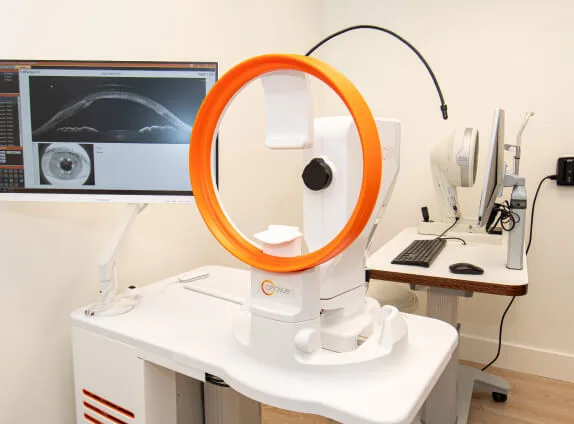
Our office is one of a few practices in the country that is equipped with the Pentacam AXL Wave and Optovue Solix OCT, which greatly aid in monitoring and managing keratoconus.
#3
Unlimited Answers
#4
The Keratoconus Specialists
#5
Access to the Doctor
#6
Affordability

Summary
Our doctors are nationally recognized for their expertise in utilizing specialty contact lenses to help individuals manage their keratoconus.
Scleral lenses are one potential option for managing keratoconus, and during the 2 hour initial comprehensive exam, the doctor will discuss other options for helping individuals manage their keratoconus.
If you have questions on treatment options for keratoconus, we can be reached at (704) 800 5230 or hello@charlottecontactlens.com.


What Our Patients Think of Us
Frequently Ask Questions
Question one
Our doctors are available to answer questions you have after your exam, and will make sure you have the information needed in order to ensure the best possible outcome.
Question two
Our doctors are available to answer questions you have after your exam, and will make sure you have the information needed in order to ensure the best possible outcome.
Question three
Our doctors are available to answer questions you have after your exam, and will make sure you have the information needed in order to ensure the best possible outcome.
Question four
Our doctors are available to answer questions you have after your exam, and will make sure you have the information needed in order to ensure the best possible outcome.
Question five
Our doctors are available to answer questions you have after your exam, and will make sure you have the information needed in order to ensure the best possible outcome.
Question six
Our doctors are available to answer questions you have after your exam, and will make sure you have the information needed in order to ensure the best possible outcome.